What Does It Actually Mean to Balance Career and Personal Life?
Career-life balance means establishing boundaries that protect personal priorities while meeting professional obligations, not achieving equal time distribution, but strategic resource allocation aligned with your values.
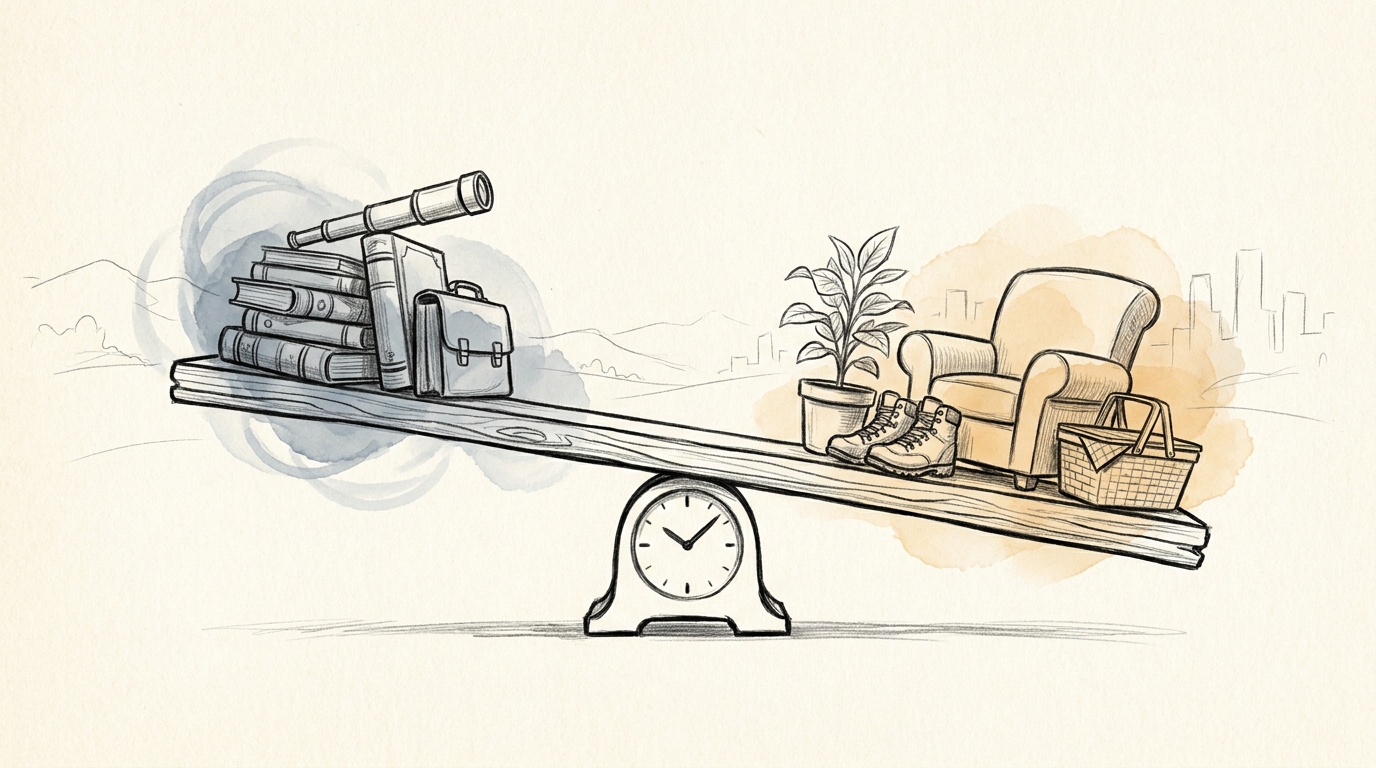
The phrase “balance career” conjures images of a perfectly even scale, with work on one side and everything else on the other. That image is misleading. Psychological sources describe genuine work-life balance as having little conflict between work and personal roles, plus enough autonomy to meet demands without one domain overpowering the other. [Source: Positivepsychology] It’s less about clock-watching and more about whether your energy, attention, and fulfillment feel sustainably distributed.
The myth of 50/50 time distribution
No one achieves a perfect split. A week with a product launch will look different from a week with a child’s school play. Trying to enforce rigid equality between work hours and personal hours creates guilt on both sides. The real question isn’t “Am I spending equal time?” but “Am I spending time on what matters most right now?”
Why ‘balance’ varies by life stage and career phase
A 28-year-old building expertise in a new field has different capacity than a 40-year-old parent managing school schedules and aging parents. Balance is dynamic. What felt sustainable three years ago may feel crushing today. In Randstad research, 93% of employees said work-life balance is important in a job, compared with 70% for career ambition, suggesting that priorities shift toward balance as careers mature. [Source: Employee Benefits]
Measuring balance through energy and fulfillment, not hours
A better metric is how you feel at the end of a typical week. Are you depleted or restored? Do you resent your calendar or feel aligned with it? A Psychometrics survey reported 80% of people believe their career should bring enjoyment and fulfillment to their life. [Source: Medium] If your work consistently drains energy without replenishing it, the balance equation is off regardless of how many hours you log.
Why Do Most Career Professionals Struggle with Balance?
Most professionals struggle because workplace cultures reward constant availability, digital tools erase work-life boundaries, and career advancement systems penalize those who set limits, creating structural barriers beyond individual control.
The always-on culture and expectation creep
Over 52% of workers now put in more than 45 hours a week, and 61% cannot unplug from their jobs. [Source: Jobera] Expectations creep upward gradually. First it’s one late email. Then it’s weekend Slack messages. Then it’s the assumption that you’re reachable at all hours. Each small concession resets the baseline of what’s considered “normal.”
Technology’s role in boundary erosion
Smartphones and collaboration tools were supposed to create flexibility. Instead, they often create an invisible leash. A 2025 global survey of 120,000 employees found 58% of workers struggle to separate work from personal life. [Source: Bewitcheryblog] When your work inbox lives in your pocket, “leaving the office” becomes a physical act without a psychological one.
Organizational incentives that punish balance
A 2026 work-life analysis finds 67.2% of workers attribute their struggles to workplace factors, including colleagues and corporate culture. [Source: Zippia] Promotion systems that reward face time over output, managers who equate late nights with dedication, and peer pressure from overworked colleagues all create environments where boundary-setting feels career-threatening. This isn’t a personal failing. It’s a structural problem.
The high cost of imbalance: burnout statistics and career impact
The consequences are measurable. A WHO and ILO-linked study found that working 55+ hours per week is associated with a 35% higher risk of stroke and 17% higher risk of heart disease compared to working 35-40 hours per week. [Source: Bewitcheryblog] Meanwhile, 74% of professionals struggle to balance work and relationships, and nearly 4 in 10 people in relationships believe work is a direct source of strain in their partnership. [Source: Bewitcheryblog]
| Burnout Driver | % of Workers Affected |
|---|---|
| Unrealistic deadlines | 38% |
| Exhaustion from long hours | 37% |
| Heavy workloads | 21% |
| No restorative downtime | 16% |
Source: Bewitcheryblog, summarizing 2025 burnout data.
What Are the Proven Strategies to Balance Career Demands with Personal Priorities?
Effective strategies include time-blocking non-negotiable personal commitments, implementing communication boundaries with clear response windows, negotiating flexible arrangements based on output rather than presence, and regularly auditing energy allocation against stated priorities.
Time-blocking: Protecting personal time with the same rigor as meetings
If a dentist appointment gets a calendar block but your child’s bedtime routine doesn’t, your system has a gap. Time-blocking personal commitments, including exercise, family meals, and recovery time, treats them as fixed obligations rather than optional extras. Career development resources highlight that professionals who actively prioritize and plan report greater satisfaction in both career and personal domains. [Source: Kennedymclean] Start with 10-20 minutes at the beginning of each week to map non-negotiable personal blocks before filling in work tasks.
Communication protocols: Setting and enforcing response expectations
Professionals who set firm boundaries on work hours were significantly less likely to report chronic stress and more likely to rate themselves as “thriving at work” than those who were constantly available, according to a 2022 survey cited by Business Talent Group. [Source: NIH] Practical steps include setting an email auto-responder after hours that specifies your response window, establishing “urgent only” criteria for after-hours contact, and turning off work notifications during meals and before bedtime.
Flexible work arrangements: Negotiating based on results, not face time
Remote workers reported a work-life balance score of 7.6 out of 10, compared to 6.9 out of 10 for office workers. [Source: The Happiness Index] When negotiating flexibility, lead with output data. Frame requests around deliverables, deadlines met, and quality metrics rather than personal preference. Managers respond better to “I produce 15% more on focused remote days” than “I’d prefer to work from home.”
Energy audits: Tracking where your attention actually goes
Time-log and reflection techniques are explicitly recommended in work-life balance programs, which advise keeping a one-week log of all activities to identify misalignment with priorities. [Source: Kennedymclean] Track your hours for one full week. Categorize every block as high-value work, low-value work, personal priority, or filler. Most people discover 5-10 hours per week spent on tasks that could be delegated, batched, or eliminated.
Strategic ‘no’: Declining commitments that don’t align with priorities
Every “yes” to a low-priority commitment is an implicit “no” to something that matters more. The 80/20 rule applies here: focus on the 20% of tasks that create 80% of results, and delegate or delay low-impact work. This isn’t about doing less. It’s about doing less of the wrong things. If you’re exploring how to develop your career strategically, learning to say no is one of the highest-leverage skills you can build.
How Do You Set Boundaries Without Damaging Your Career Prospects?
Set boundaries by framing them around productivity and output, communicating them proactively rather than reactively, demonstrating consistent high performance within those boundaries, and choosing employers whose cultures genuinely support sustainable work practices.
Framing boundaries as performance optimization
A 2023 global survey by Deloitte and Workplace Intelligence found 77% of workers have experienced burnout in their current job, and 84% say improving their well-being is a top priority when looking at new jobs. [Source: Indeed] Gallup’s research on employee engagement shows that employees with better work-life balance are 21% more productive and 41% less likely to miss work. [Source: Indeed] These numbers give you a data-backed argument: boundaries aren’t about doing less, they’re about sustaining higher output over time.
Proactive communication strategies
Announce boundaries before they’re tested, not after. Tell your manager, “I’m most responsive between 8 a.m. and 6 p.m., and I check messages once in the evening for anything urgent.” This sets expectations clearly. Reactive boundary-setting (“I can’t do that, I’m off the clock”) feels like refusal. Proactive communication feels like professionalism.
Building credibility through consistent delivery
Boundaries hold up when your work speaks for itself. Deliver consistently within your stated hours, meet deadlines reliably, and over-communicate progress. When colleagues see that your boundaries don’t reduce your output, resistance fades. The key is pairing limits with visible results.
Recognizing when organizational culture is incompatible
Sometimes the problem isn’t your boundary-setting skills. It’s the organization. If 60% of employees blame bad bosses for the most negative impact on their work-life balance, as survey data suggests, then individual optimization has limits. [Source: Zippia] When a culture actively punishes boundaries despite strong performance, the most strategic move may be to leave. That’s not failure. It’s self-preservation.
What Role Does Career Choice Play in Achieving Balance?
Career choice significantly impacts balance potential. Roles with predictable schedules, output-based evaluation, remote flexibility, and organizational cultures that model healthy boundaries enable sustainable integration far more than high-pressure, always-on environments.
Industries and roles with structural balance advantages
Grand Canyon University’s analysis notes that some career paths are naturally more demanding than others, highlighting sectors like accounting and event planning where company culture is the top barrier to work-life balance. [Source: GCU] Roles with clear deliverables, predictable workflows, and minimal after-hours emergencies tend to offer structural advantages. If you’re researching career transitions, consider how a role’s inherent demands align with your personal priorities.
Red flags during job search: Identifying unsustainable cultures
Accenture’s global “Defining Success” study found more than half (52%) of professionals have turned down a job because of concerns about its impact on work-life balance. [Source: The Happiness Index] Watch for red flags: job listings that mention “fast-paced” repeatedly, interviewers who brag about long hours, Glassdoor reviews citing burnout, and vague answers about remote or flexible policies.
Questions to ask during interviews about work-life integration
Ask specific, behavioral questions: “What does a typical week look like for someone in this role?” “How often do team members work evenings or weekends?” “What’s the company’s approach to after-hours communication?” Vague answers like “We work hard and play hard” are a warning sign, not a reassurance.
When to consider a career pivot for better balance
Careershifters reports that 41% of career changers cite poor work-life balance or wellbeing as a leading motivation for changing careers. [Source: The Happiness Index] Meanwhile, 83% of workers say work-life balance is the most important factor when choosing a job, ranking above pay for the first time. [Source: The Happiness Index] If your current field structurally prevents balance, pivoting isn’t giving up. It’s choosing a game you can actually win.
How Do You Balance Career Ambition with Personal Fulfillment?
Balance ambition with fulfillment by defining success on your own terms rather than external metrics, pursuing career growth that compounds rather than consumes personal capacity, and regularly reassessing whether your career trajectory aligns with evolving life priorities.
Redefining success beyond traditional career metrics
A US analysis found 80% of job seekers and 84% of hiring managers now define success more in terms of work-life balance than traditional career progression. [Source: Medium] Title, salary, and corner offices are one version of success. Meaningful work, strong relationships, physical health, and time autonomy are another. The most sustainable careers tend to optimize for both, not sacrifice one entirely for the other.
Sustainable ambition: Growth that builds rather than depletes
In Flywheel Associates’ State of Work & Career Success Survey, 52% of workers said their professional ambition is not tied to being part of a company, reflecting a shift toward more self-defined and flexible career paths. [Source: Medium] Sustainable ambition means choosing growth opportunities that build skills, relationships, and reputation without requiring you to sacrifice sleep, health, or family for years at a time.
The compounding effect of aligned priorities
When career goals and personal values point in the same direction, effort compounds. A professional who values creativity and chooses a creative role doesn’t have to “recover” from work the same way someone in a misaligned position does. Work-life integration is associated with higher job satisfaction and lower stress, according to research summarized by Moen, Kelly, and Lam (2013). [Source: Medium]
Periodic recalibration: When to adjust course
Schedule a quarterly “life audit.” Review whether your current workload, role, and trajectory still align with what matters most. Priorities shift. Children grow. Health changes. Career interests evolve. The professionals who maintain balance long-term are those who recalibrate regularly rather than waiting for a crisis to force a change.
What Are the Warning Signs That Your Career-Life Balance Is Unsustainable?
Warning signs include chronic physical exhaustion, deteriorating relationships, inability to enjoy personal time without work intrusion, declining work quality despite longer hours, and persistent resentment toward career demands, all indicators requiring immediate intervention.
Physical and mental health indicators
Persistent fatigue, even after adequate sleep, is one of the earliest signals. The OECD reports that more than 11% of U.S. workers routinely work very long hours, ranking the U.S. 30th out of 38 countries for work-life balance. [Source: Fortune] Recurring headaches, muscle tension, stomach issues, and blood pressure changes that worsen during high-workload periods are your body’s way of telling you the current pace is unsustainable.
Relationship and social connection deterioration
When you consistently cancel plans, miss family events, or feel too drained to engage with people you care about, your balance has tipped. A report on high achievers found 64% of founders spend significantly less time with friends and family after starting their companies. [Source: Medium] Relationships don’t deteriorate overnight. They erode through hundreds of small absences.
Performance paradox: Working more, achieving less
One of the cruelest ironies of overwork is diminishing returns. When you’re exhausted, tasks that should take an hour take three. Creativity drops. Decision quality suffers. You work longer to compensate, which deepens the exhaustion. If your output is declining despite increasing hours, that’s a clear signal to change course, not push harder.
Emotional signals: Resentment, anxiety, and detachment
Frequent irritability, cynicism, and emotional numbness are repeatedly cited as signs of unhealthy balance. [Source: Leitz] If you resent your job, dread Monday mornings with visceral intensity, or feel detached from work that once engaged you, these aren’t personality flaws. They’re data points telling you something needs to change.
How Do You Recover from Burnout While Maintaining Career Momentum?
Recover from burnout by taking strategic recovery time without guilt, rebuilding boundaries systematically, delegating or eliminating low-value work, and communicating transparently with managers about sustainable workload, treating recovery as essential maintenance, not career derailment.
Strategic recovery: Taking time without career penalty
Recovery doesn’t always mean quitting or taking a sabbatical. It can mean using accumulated PTO without checking email, requesting a temporary workload reduction, or taking a mental health day. The key is framing recovery as performance investment. Athletes don’t train through injuries. Neither should knowledge workers.
Rebuilding boundaries after burnout
Burnout often follows a period where boundaries eroded gradually. Rebuilding them requires deliberate action: reinstating work-hour limits, re-establishing communication protocols, and being explicit with colleagues about your availability. Start with one boundary, enforce it consistently for two weeks, then add another.
Workload negotiation and delegation tactics
Approach your manager with data, not complaints. “I’m currently managing X projects with Y deadlines. To maintain quality, I’d like to discuss prioritization.” Identify tasks that can be delegated, automated, or deferred. The 80/20 principle applies again: eliminate the 80% of low-value work consuming your time.
Preventing recurrence through systemic changes
Individual recovery without systemic change leads to repeat burnout. Evaluate whether your role, team, or organization can support sustainable work patterns. If the answer is no after genuine effort, a strategic exit may be the healthiest choice. FlexJobs survey data shows that 37% of respondents are stressed by their level of work-life balance, up from 29% in 2015, indicating balance is getting harder, not easier. [Source: Bewitcheryblog] Sometimes the system needs to change. Sometimes you need to change systems.
Ready to position yourself for roles that support sustainable success? Resumeio.com’s resume builder helps you highlight the skills and achievements that demonstrate your value, making it easier to negotiate the boundaries and flexibility you need. Build your resume now.
Frequently Asked Questions
These are the most common questions mid-career professionals ask about managing the tension between career demands and personal priorities.
Is work-life balance actually achievable, or is it a myth?
It’s achievable, but not as a fixed state. Balance is a dynamic process of setting and adjusting boundaries based on current priorities. Research shows professionals who actively manage boundaries report higher satisfaction and lower burnout than those who don’t.
Will setting boundaries at work hurt my chances of promotion?
Not when paired with consistent high performance. Gallup research shows employees with better work-life balance are 21% more productive and 41% less likely to miss work. Framing boundaries around output, not availability, protects both your well-being and your career trajectory.
How do I know if my work-life balance is actually unhealthy?
Key warning signs include chronic fatigue despite adequate sleep, deteriorating personal relationships, inability to enjoy time off without checking work messages, and declining work quality despite longer hours. If multiple signs are present, intervention is needed.
Should I change careers to get better work-life balance?
Career change is worth considering when your current field structurally prevents balance. Data shows 41% of career changers cite poor work-life balance as a leading motivation. However, try boundary-setting and negotiation within your current role first, since the issue may be organizational rather than occupational.
How can I balance career ambition without burning out?
Focus on sustainable growth. Choose opportunities that build skills and reputation without requiring chronic overwork. Research shows 80% of job seekers now define success in terms of work-life balance rather than traditional career progression, suggesting ambition and balance aren’t mutually exclusive.
What’s the best way to recover from career burnout?
Start with immediate recovery actions like using PTO without email access, then rebuild boundaries systematically. Negotiate workload adjustments with your manager using data about your current responsibilities. Address systemic causes, not just symptoms, to prevent recurrence.
Does remote work actually improve work-life balance?
Research from The Happiness Index found remote workers reported a work-life balance score of 7.6 out of 10, compared to 6.9 for office workers. However, remote work can also blur boundaries further if you don’t establish clear start and stop times. The arrangement helps, but intentional boundaries are still essential.
How do I talk to my manager about needing better balance?
Lead with performance data and solutions, not complaints. Frame the conversation around sustaining your output quality: “To continue delivering at this level, I’d like to discuss prioritizing my current projects.” Propose specific, actionable changes rather than vague requests for “less work.”